

There is no one-size-fits-all battery for electric vehicles. Just as with internal combustion engines, automakers choose different technologies based on cost, driving range, performance, and durability. That is why multiple battery chemistries coexist in today’s market, each with clear strengths and weaknesses.
If you are interested in the world of electric vehicles—whether as a buyer, a casual observer, or an enthusiast—this guide will help you understand which battery types are used today, which ones are fading away, and which technologies are set to transform the industry in the coming years.
Lead-acid batteries: where it all began
Lead-acid batteries are the oldest rechargeable batteries still widely used today. They are inexpensive, reliable, and easy to recycle, and they still power the 12-volt auxiliary battery in both gasoline and electric vehicles.
However, their low energy density and heavy weight make them unsuitable for powering modern electric cars. As a result, their role is now limited to secondary functions such as lighting, windows, and infotainment systems.
Nickel-metal hydride (NiMH): essential for hybrids
NiMH batteries were the bridge technology before lithium-ion became dominant. They are durable and tolerant of extreme climates, which is why they remain common in many hybrid vehicles, especially those produced by Toyota.
That said, their higher weight and lower efficiency compared to lithium batteries are driving a gradual transition toward more advanced solutions.
NMC and NCA: the kings of long range
Nickel Manganese Cobalt (NMC) and Nickel Cobalt Aluminum (NCA) chemistries dominate the long-range electric vehicle market outside China. Automakers such as BMW, Volkswagen, Hyundai, Kia, and Tesla rely heavily on these batteries.
Their main advantages are high energy density and strong performance, but they also come with higher costs, reduced efficiency in cold weather, and lower thermal stability compared to other options.
LFP: the battery powering the mass market
Lithium iron phosphate (LFP) technology has gained global traction thanks to being more affordable, safer, and longer-lasting. By eliminating expensive materials like nickel and cobalt, LFP batteries reduce costs and dependence on complex supply chains.
While they offer lower energy density, manufacturers offset this with more efficient cell designs, making LFP batteries a popular choice for affordable electric vehicles.
What’s next: LMFP, LMR, and beyond
Innovation continues at a rapid pace. Emerging chemistries such as LMFP (lithium manganese iron phosphate) and LMR (lithium manganese-rich) aim to combine lower costs with extended driving range, while reducing reliance on expensive raw materials.
Automakers like General Motors and Ford are already developing these batteries, targeting ranges of over 400 miles in electric SUVs and trucks later this decade.
The future: solid-state, sodium, and lithium metal
Among the most promising breakthroughs are solid-state batteries, which could deliver longer range, faster charging, and improved safety. However, large-scale, cost-effective production remains a challenge.
Other alternatives include sodium-ion batteries, well suited for affordable EVs, and lithium-metal batteries, which promise record energy density but are still in the experimental stage.
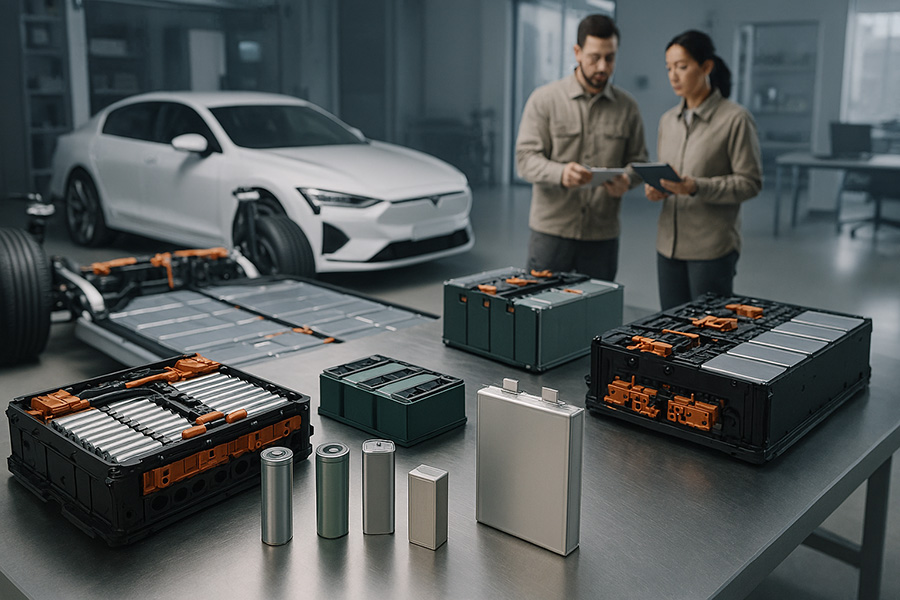
Ultimately, battery chemistry is only part of the equation. Cell format and vehicle integration also play a major role in efficiency, design, and overall driving experience.
If you are considering making the switch to electric mobility and want to compare models, prices, and technologies, you can explore new and used electric vehicle options on the vehicle buying and selling marketplace, where you will find choices to suit different budgets and needs.
The future of electric vehicles is being written today—and it starts with the battery.