

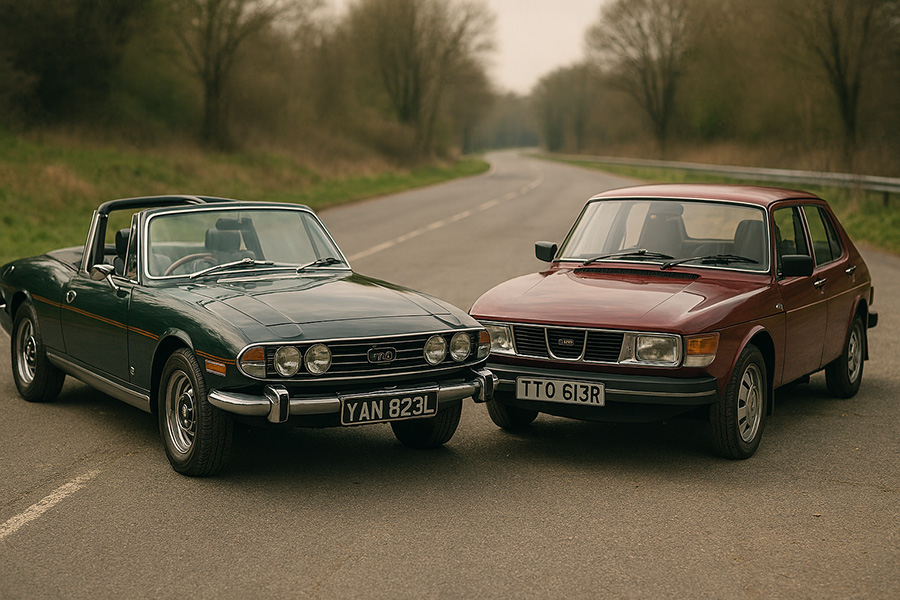
The story of the Triumph Stag V8 is one of those automotive oddities that blends ambition, questionable engineering, and unexpected consequences. What’s most curious is that part of that DNA ended up giving life to the Saab 99, one of the Swedish manufacturer’s most iconic models. Yes, as incredible as it sounds, both projects have been connected since the mid-1960s.
While Triumph was searching for a new engine to replace designs dating back to the 1940s, Saab was working with the British consultancy Ricardo Engineering to develop the powerplant for its upcoming 99. For cost reasons, Ricardo decided to bring both paths together, resulting in one of the most peculiar slanted four-cylinder engines of the era, which would eventually be used by both Saab and Triumph.
A shared engine… and an even riskier idea
The result of that collaboration was the Triumph slant-four, a four-cylinder overhead-cam engine that also powered the Triumph Dolomite from 1971 onward. But Triumph went a step further: it decided to join two of these engines to create the Stag V8, a 2.5-liter powerplant that later grew to 3.0 liters.
So rather than saying the Saab 99 used “half a Stag V8,” it would be more accurate to say that the Triumph Stag was powered by two Saab 99 engines. A bold idea… and a problematic one.
The many sins of the Triumph Stag V8
The list of faults associated with the Stag V8 is long and legendary. To begin with, its Bosch mechanical fuel injection proved extremely unreliable. Triumph switched to carburetors, but that reduced power, leading engineers to increase displacement by boring out the block.
That increase brought new problems:
- Thinner cylinder walls, negatively affecting cooling
- Reduced coolant passages, combined with a water pump prone to failure
- A water pump mounted higher than the radiator, requiring the car to be tilted backward to properly bleed the system
When coolant leaked—which was not a matter of “if” but “when”—the engine would overheat rapidly. Add to that warp-prone aluminum cylinder heads, electrolysis issues, and timing chains that needed replacement every 25,000 miles, a critical flaw in an interference engine.
It’s no surprise that the Stag earned a reputation as one of the most problematic V8 engines in history.
Saab flirts with the V8… and is saved by the turbo
Saab did consider using the Stag V8 in the 99. In fact, around 48 experimental units were built, likely making it one of the most unfortunate engine swaps ever attempted. Fortunately, engineer Per Gillbrand proposed a far more logical alternative: the turbo.
The idea was simple and brilliant: if engines already have oil, fuel, and water pumps, why not add an air pump? That’s how the Saab 99 Turbo was born. Introduced in 1977, it produced 145 horsepower—exactly the same as the Stag V8, but with greater reliability and efficiency.
From then on, Saab developed a clear aversion to V8 engines. Even an experimental prototype based on the Saab 9000 never reached production, reinforcing the brand’s commitment to small, turbocharged engines.
V8s, Saab, and oddities that stood the test of time
Although Saab never produced its own V8 for mass production, the world came close with the Lancia Thema 8.32, a technical cousin of the Saab 9000 that featured a Ferrari V8 tuned by Ducati. And yes, there was also the Saab 9-7X Aero with an LS2 engine—though it was more of a Chevrolet Trailblazer in disguise than a true Saab.
For enthusiasts of these unique mechanical stories and classics with a peculiar past, exploring the market is