

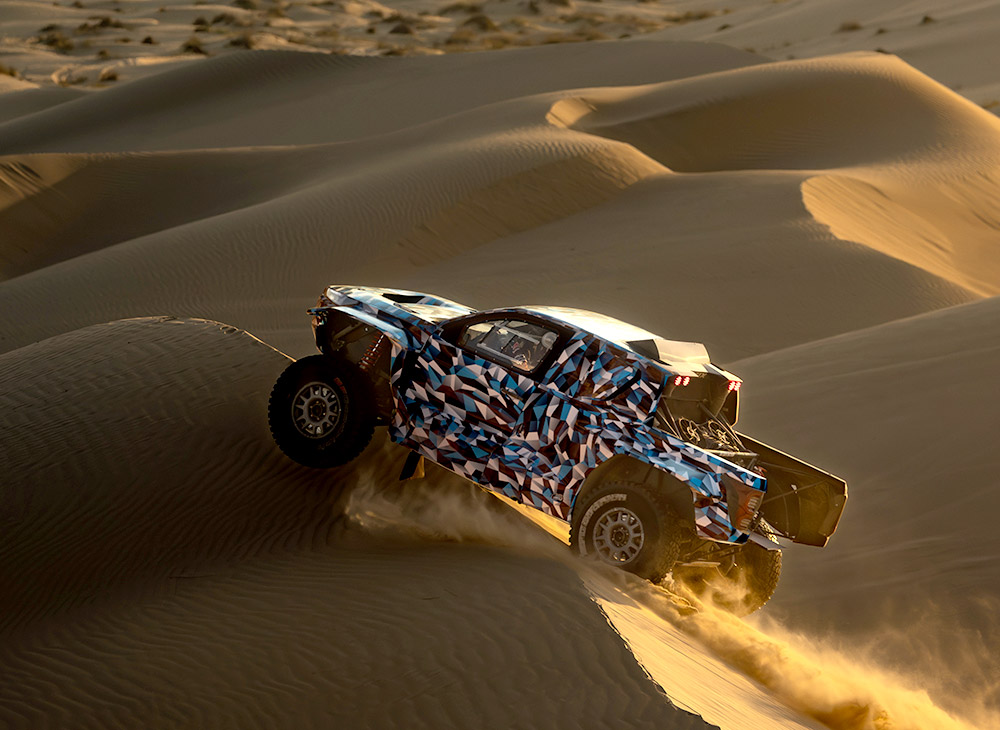
Toyota GAZOO Racing has unveiled one of its most ambitious motorsport projects to date, announcing that it will compete in the 2027 Dakar Rally with the new DKR GR FC Hilux, a prototype powered by hydrogen fuel cell (Fuel Cell Electric Vehicle – FCEV) technology. The initiative is part of Toyota’s long-term strategy to accelerate the development of low-emission mobility solutions by testing them under the toughest racing conditions in the world.
By using one of the most demanding off-road competitions as a development platform, Toyota aims to prove that hydrogen-powered technology can deliver exceptional reliability, durability, and performance in extreme environments.
The Dakar Rally as a Technology Test Bed
Rather than serving as a simple technology showcase, the project is designed to validate the capabilities of hydrogen fuel cell technology in real-world racing conditions. The DKR GR FC Hilux is based on Toyota’s successful Dakar-winning Hilux platform but replaces the conventional internal combustion engine with an advanced hydrogen fuel cell system developed by Toyota.
One of the major advantages of this powertrain is that it produces zero direct CO₂ emissions while driving, with water vapor being the system’s only by-product.
The intense heat, massive sand dunes, rocky terrain, and marathon stages of the Dakar Rally provide the ideal environment to push the technology to its limits. Engineers have focused on improving energy efficiency, enhancing cooling performance, reducing the size of the fuel cell system, and increasing its durability under the harshest operating conditions.
Technology That Will Benefit Future Production Vehicles
Toyota believes the knowledge gained during the development and competition program will extend far beyond motorsport.
The innovations tested in the DKR GR FC Hilux are expected to support the next generation of passenger vehicles, trucks, buses, trains, boats, and other hydrogen-powered transportation solutions. The experience gathered by Toyota’s engineering teams will also help accelerate the development of cleaner and more efficient mobility technologies.
The prototype’s powertrain, software, and overall vehicle integration are currently undergoing extensive testing in Belgium ahead of its official competition debut in 2027.
Competing in the Future Mission 1000 Category
The DKR GR FC Hilux will compete in the Dakar Future Mission 1000 category, a special class dedicated to experimental vehicles and emerging propulsion technologies.
The competition consists of approximately 1,000 kilometers of timed stages spread over 13 days, providing manufacturers with the opportunity to demonstrate the performance, safety, and reliability of next-generation mobility solutions under real racing conditions.
Toyota Continues to Expand Its Hydrogen Strategy
The Dakar project represents another important milestone in Toyota’s commitment to hydrogen technology. Since 2021, the company has introduced several hydrogen-powered racing projects, including the Corolla H2 competing in Japan’s Super Taikyu Series, the GR Yaris H2 showcased during the FIA World Rally Championship (WRC), the HySE-X Dakar Future Mission prototypes, and the TR LH2 Racing Prototype, which completed demonstration laps during the 2026 24 Hours of Le Mans.
With the 2027 Dakar Rally, Toyota will become one of the first manufacturers to combine hydrogen fuel cell technology with international cross-country rally competition, reinforcing its commitment to carbon neutrality while demonstrating that motorsport remains one of the world’s most valuable laboratories for developing the vehicles of tomorrow.
If you’re interested in Toyota models or planning to buy your next vehicle, you can browse a wide selection of Toyota vehicles for sale, including both new and pre-owned models.