

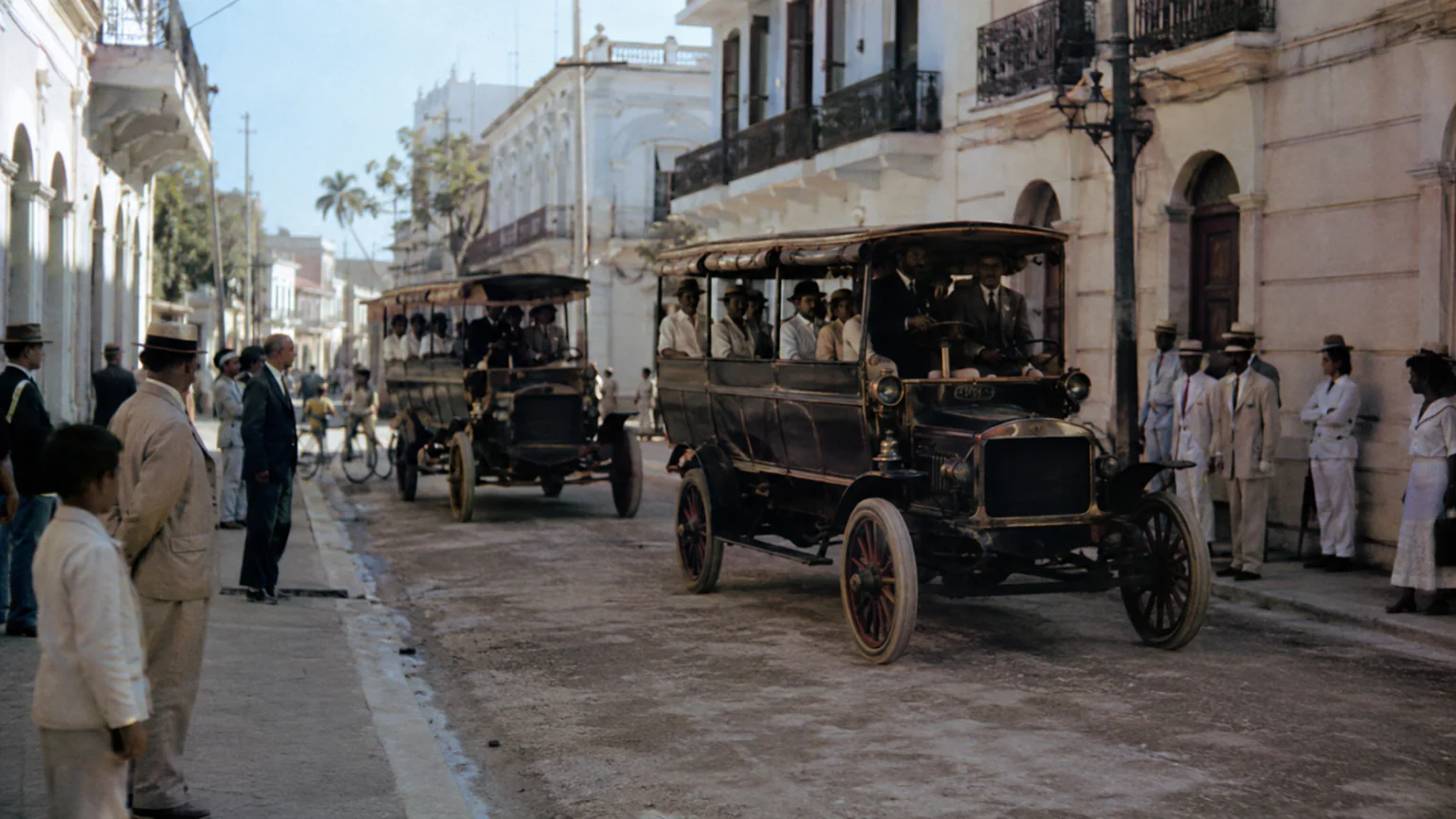
The history of the automobile in the Dominican Republic began more than a century ago, when motor vehicles were still a rarity and much of the country’s transportation depended on horses, carriages, pack animals and railways.
Although it is often stated that the first automobile arrived in the country in **1907**, the history is somewhat more complex. Historical research suggests that a vehicle may have arrived earlier in Puerto Plata, while 1907 represents the moment when the automobile began to become visible as a means of public transportation in Santo Domingo.
A Car May Have Arrived Before 1907
Determining exactly which was the first automobile to travel through Dominican territory is not easy.
According to research by Dominican historian Santiago Castro Ventura, documented in his work El automóvil y las vías de comunicación en la historia dominicana, there are references to the presence of an automobile in Puerto Plata before the organized introduction of these vehicles in Santo Domingo.
However, the available documents do not provide enough certainty to establish the make or model of that vehicle.
This means it is not possible to categorically state that Ford, Chevrolet, Buick or any other manufacturer produced the first automobile to arrive in Dominican territory.
Puerto Plata was also a particularly favorable location for the arrival of new technologies. At the end of the 19th century and the beginning of the 20th, it was one of the country’s main commercial ports and maintained maritime and railway connections with important economic centers in the Cibao region.
1906: Plans to Import Automobiles Begin
Before automobiles became a regular presence in Santo Domingo, entrepreneurs were already interested in turning them into a business.
In 1906, Cuban businessman Pedro Marín, who lived in Santo Domingo, publicly announced plans to invest in importing several automobiles.
This is important because it shows that the automobile did not arrive merely as a technological curiosity. It was also beginning to be seen as a business opportunity and as a potential solution for passenger transportation.
1907: The Automobile Enters Public Transportation in Santo Domingo
The year 1907 is the most important reference point when discussing the beginnings of the automobile in the Dominican Republic.
That year, the first vehicles intended for public transportation began operating in Santo Domingo, generating enormous curiosity among residents of the capital.
According to historical research, Osvaldo Báez, son of former President Buenaventura Báez, announced in April 1907 that an automobile would be used to provide transportation between the Ozama area and San Gerónimo.
The arrival of the first omnibus-type vehicles turned the automobile into a genuine public spectacle.
For a society accustomed to traveling primarily by horse, carriage and other traditional means, seeing a motor-powered machine moving through the streets represented a considerable technological transformation.
The first automobiles were not received with enthusiasm alone. The noise of their engines, the smoke and the odors they produced were unfamiliar to a population accustomed to a different type of transportation.
The First Private Automobile Arrived a Few Years Later
Another important moment occurred in 1911, when historical sources cited by Castro Ventura indicate that a private automobile from the United States arrived at the port of Santo Domingo.
That same year, other vehicles intended for public transportation also arrived.
The difference between these two developments is significant. While the first automobiles used for public transportation were intended to demonstrate the commercial usefulness of the new technology, private vehicles began to represent a new form of individual mobility, particularly associated with entrepreneurs and wealthier individuals.
The Automobile Needed More Than Gasoline
The expansion of the automobile created a fundamental problem: Dominican roads were not yet prepared for them.
At the beginning of the 20th century, much of the country’s land transportation depended on rudimentary roads. Railways were also considerably important, particularly in the northern part of the country.
As a result, the arrival of automobiles also increased the need to improve roads, establish new regulations and develop services related to vehicles.
The expansion was gradual.
Historical research places the arrival of the automobile in Baní in 1914, while in 1915 an automobile route between Moca and Santiago was recorded. A year later, a vehicle reached San José de las Matas through a still-rudimentary road connection.
The history therefore shows that the growth of the automobile and the construction of roads were closely interconnected processes.
So, What Was the First Make?
This is probably the question that generates the most curiosity among automobile enthusiasts.
The most rigorous answer is: the make of the first automobile to arrive in the Dominican Republic is not known with certainty.
The vehicle associated with Puerto Plata has not been conclusively identified, and there is also insufficient documentation to attribute the first vehicles that began operating in Santo Domingo in 1907 to a specific manufacturer.
But there is another date that does allow us to clearly identify a make.
Chevrolet and the Birth of the Dominican Automotive Market
In 1920, Italian businessman Amadeo Barletta founded Santo Domingo Motors.
The company initially represented Chevrolet, a brand belonging to General Motors, and became one of the companies that played a fundamental role in the development of formal automobile distribution in the Dominican Republic.
According to the company’s history, it was established on September 12, 1920, and its first year of operations was quite modest, with only three vehicles sold.
One of the most interesting details is that the Chevrolet 490 is identified as the first model marketed by Santo Domingo Motors that year.
For this reason, Chevrolet holds a special place in Dominican automotive history. It cannot be stated that Chevrolet manufactured the first automobile to arrive in the country, but its importance in the beginning of organized automobile distribution is documented.
Automobiles Began to Transform Dominican Society
During the 1920s, vehicles ceased to be merely a technological novelty.
The growth of the vehicle fleet created new needs and economic activities: repair shops, fuel sales, spare parts, drivers and other vehicle-related services.
Automobiles also began to become part of public institutions.
Historical documents from the period, for example, show discussions between Santo Domingo Motors and the government of Horacio Vásquez involving vehicles from brands such as Cadillac and Packard.
The automobile was thus becoming part of Dominican commerce, public administration and urban life.
From a Few Vehicles to Thousands
Growth was considerable during the first decades of the 20th century.
A 1937 publication on automobile use in Latin America estimated that the Dominican Republic had approximately 2,880 motor vehicles, including automobiles, buses and trucks, in addition to motorcycles.
A significant portion of these vehicles was concentrated in Santo Domingo, while Santiago and San Pedro de Macorís also had a substantial presence.
In roughly three decades, the country had gone from having a handful of pioneering automobiles to having thousands of vehicles.
The Automobile Also Became Part of Political History
The importance of the automobile was not limited to transportation.
During the 20th century, vehicles became tools of mobility, communication and power. They also became linked to some of the most important political episodes in Dominican history.
During the dictatorship of Rafael Leónidas Trujillo, automobiles were used both by the regime and by its opponents.
The role of vehicles became particularly significant during the events that culminated in the assassination of Trujillo on May 30, 1961, when several automobiles were connected to the conspirators and to the pursuit of the dictator’s vehicle.
This demonstrates how the automobile had ceased to be merely a technological innovation and had become part of the country’s economic, social and political life.
From the First Automobiles to Modern Traffic
The growing number of vehicles made it necessary to establish an increasingly complex regulatory system.
Over the decades, regulations emerged concerning vehicle registration, traffic, public transportation and road safety.
The institutional evolution eventually led, in modern times, to the creation of the Instituto Nacional de Tránsito y Transporte Terrestre (INTRANT) through Law 63-17 of 2017.
The situation today is very different from that of 1907. The country went from worrying about how to adapt its streets to the first automobiles to managing millions of journeys involving cars, motorcycles, buses, trucks and other means of transportation.
A History That Began Long Before the Major Dealerships
The history of the automobile in the Dominican Republic cannot be reduced to a single date or a single make.
An automobile may have arrived in Puerto Plata before 1907, but 1907 represents the best-documented beginning of public motor transportation in Santo Domingo.
Private vehicles arrived later, routes between cities emerged, and roads and automobile-related services began to develop.
Finally, in 1920, the arrival of Santo Domingo Motors as a representative of Chevrolet marked a new chapter: the birth of a formal automobile distribution industry.
For those who want to learn more about the early years of the automobile in the country, DominicanScope published an investigation into the history of automobiles in the Dominican Republic, based on historical research that includes the work of Santiago Castro Ventura.
So, What Was the First Automobile in the Dominican Republic?
The most accurate answer is that there is still insufficient historical evidence to identify with certainty the make and model of the first automobile to arrive in Dominican territory.
What can be established more clearly is that 1907 was a decisive year for the introduction of motor transportation in Santo Domingo and that Chevrolet, through Santo Domingo Motors, played a fundamental role in the creation of the formal automotive market beginning in 1920.
More than the story of a single automobile, this is the story of how a new technology gradually changed the way Dominicans traveled, conducted business and built their cities.